Can we reconnect American housing to sustainably-managed local and regional forests?
The Forest History Society will hold a Slow Wood: Connecting Forest History with Ecological Forestry & Green Building webinar on February 26th from 1 to 2 pm ET.
Through the colonial period, houses were mostly constructed and heated directly from local woodlands, but the sustainability of that relationship is debatable. During the nineteenth century, the lumber industry was transformed to a system of national large-scale extraction with devastating consequences.
Today, although wood production in America has become a more renewable resource in the limited sense of “sustained yield,” not much of housing ties to diverse local forests that provide multiple ecological benefits. Should it?
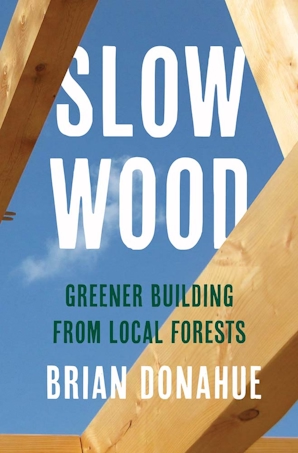
Slow Wood describes how author Brian Donahue built a timber frame house from the woods on his farm, utilizing “low grade” trees (hemlock, black birch, suppressed sugar maple, and crooked cherry) through “worst first” ecological forestry. Donahue is Professor Emeritus of American Environmental Studies at Brandeis University, an environmental historian, and farm and forest policy consultant.
In this webinar, Donahue and guest host Tania Munz will discuss the potential role of traditional methods in housing modern America.
To take part in this webinar, register at Webinar Registration – Zoom