
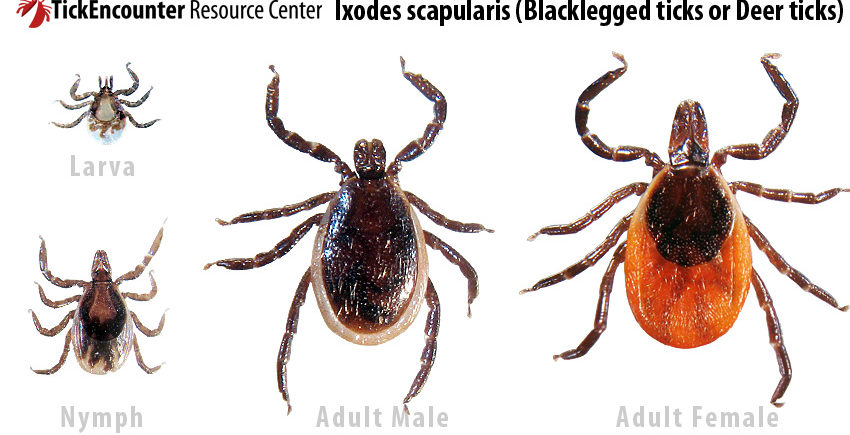
What is the greatest risk encountered by those who work in our woods in the warm weather months? Getting hit by a falling tree? Getting attacked by a bear? Getting trampled by a moose? While any of the above could be truly traumatic, such incidents are thankfully quite rare.
The greatest danger faced by members of the forest community is getting bit by the black-legged deer tick. More than 300,000 people in the U.S. contract Lyme disease every year, primarily in the Northeast, and Lyme disease is primarily transmitted by deer ticks. Lyme disease can cause major illnesses and even result in total disability or even death. Everybody in forestry knows someone who has had a bad case of Lyme disease. What is worse, there is no resistance to Lyme disease, so you can get it again, and again, and so on.
Ticks are much more common that they were 10 or 20 years ago, a symptom of our warming temperatures. Ticks like moist warm environments and our woods provide perfect habitat for ticks. From the time the snow shrinks in late winter or spring until mid summer, it seems like there are ticks everywhere these days.
Dr. Steven Rich from UMass gave a presentation about ticks at MFA’s Annual Meeting last October. He said that the reason there seem to be a huge explosion of ticks is because there has been a huge rise in the white-tailed deer population in the Northeast and deer carry up to 1,000 ticks each.
The most common tick-borne diseases in Massachusetts are Lyme Disease, Babesiosis, and Anaplasmosis. Other diseases that are more rare, but still occur, are Tularemia, Rocky Mountain spotted fever, Borrelia miyamotoi, and Powassan virus.
Besides the black-legged deer tick, there is now a new tick to worry about, particularly if you visit Cape Cod or Martha’s Vineyard. The lone star tick (Amblyomma americanum), as small as a poppy seed, whose adults females have a white dot on their back (the “lone star”), carries diseases including alpha-gal syndrome, bourbon virus, ehrlichiosis, heartland virus disease, southern tick-associated rash illness (STARI) and tularemia.
Many of these illnesses can be severe if not treated right away.
Alpha-gal syndrome causes victims to become allergic to red meat such as beef, pork or chicken.
To prevent tick bites, you need to take adequate precautions. Wear long sleeved shirts, boots and long pants when in the woods in the warm weather months. Treat your clothing and boots with permethrin. Put a tick repellent like picardin or insecticides with DEET on exposed skin.
Studies have shown that edge habitats like field edges, stone walls and the zone along roads or lots with lots of low vegetation are hot spots for ticks. If you are spending time in those zones, you are much more likely to come into contact with ticks.
Ticks do not fly or jump. They attach to animals or people that come into direct contact with them.
One of the most important things you can do is check yourself for ticks once a day. Favorite places ticks like to go on your body include areas between the toes, back of the knees, groin, armpits, and neck, along the hairline, and behind the ears.
Remove any attached ticks as soon as possible. If you discover a tick, remove it carefully with tweezers and dispose of it. Watch for signs that you’ve been bit and been infected and get treatment quickly.
Talk to your doctor if:
- you develop a rash where you were bitten or experience symptoms of a tick-borne infectious disease such as fever, headache, fatigue, or sore and aching muscles; or
- you have stomach or intestinal symptoms such as nausea, vomiting or diarrhea or signs of an allergic reaction like face or tongue swelling, or an itchy rash (hives) within several hours after eating meat or dairy products.
For more information about ticks and steps to take to prevent tick bites, see this state website: www.mass.gov/tick-borne-diseases